
Driven by Policies and Raw Materials, 304 Stainless Steel Prices Surge in January 2026, High-End Properties Support Market Demand
2026-01-27
Driven by Policies and Raw Materials, 304 Stainless Steel Prices Surge in January 2026, High-End Properties Support Market Demand
In January 2026, China's stainless steel market showed a volatile upward trend, with 304 stainless steel, as a mainstream variety, achieving significant price gains and strong resilience. According to spot market data in Wuxi, as of January 23, the price of Taiyuan Iron and Steel 304 cold-rolled coils ranged from 14,800 to 14,900 yuan per ton, an increase of 1,300 yuan per ton month-on-month, representing a 9.59% growth, and an 8.79% year-on-year increase. This price increase is not a short-term fluctuation but the result of the resonance of multiple factors, including raw material cost support, policy-driven demand, and optimized supply-demand structure, indicating a continuous recovery in industry prosperity.
The raw material side has become the core driver of price increases, with key raw materials such as nickel and chromium rising simultaneously. Affected by expectations of reduced nickel ore quotas in Indonesia in 2026, ferronickel costs have surged sharply, with the ex-factory price of 8-12% high-grade ferronickel reaching 1,042.5 yuan per nickel point. Coupled with tight supply chains of South African chrome ore, the long-term contract purchase price of high-carbon ferrochrome for South China steel mills in February rose by 50 yuan to 8,245 yuan per 50 base tons, with dual cost pressures continuously passing on to the terminal market. Policy dividends have further amplified the upward trend. The implementation of China's "Two New Policies" (large-scale equipment renewal and consumer goods trade-in) has driven steady demand in sectors such as new energy vehicles and high-end manufacturing even in the off-season. The production of 300-series stainless steel in January reached 1.7632 million tons, a month-on-month increase of 0.92%, continuously optimizing the supply-demand pattern.
The inherent performance advantages and technological upgrades of 304 stainless steel have enhanced its market competitiveness amid the price increase cycle. Traditional 304 stainless steel, with a classic composition of 18% chromium and 8% nickel, boasts excellent atmospheric corrosion resistance, cold forming and welding performance. Technological breakthroughs since 2025 have further achieved performance leaps—gradient-structured 304 stainless steel has increased its yield strength by 2.6 times to over 530MPa, while nanocrystalline 304 stainless steel has 6-7 times higher hardness than traditional products, maintaining a 33% elongation rate and breaking the industry bottleneck of "trade-off between strength and ductility". Compared with 316L stainless steel, 304 stainless steel is 20-30% lower in cost, offering significant cost-performance advantages. It is widely used in new energy vehicle parts, food machinery, architectural decoration and other fields, seizing opportunities in policy-driven high-end demand growth.
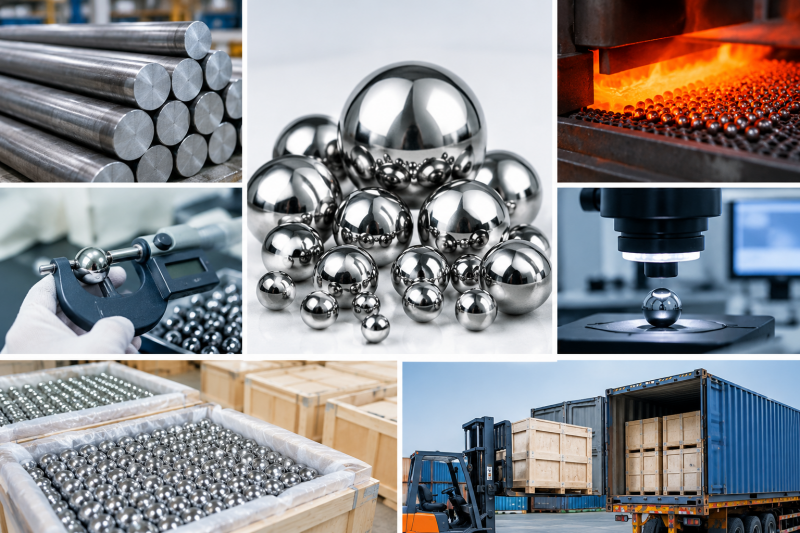
Feige Steel Ball keeps pace with market trends, focusing on R&D and production of 304 stainless steel products, offering a full range of 304 stainless steel balls and plates from 0.5mm to 150mm, covering ordinary and nano-reinforced series. Equipped with an AI intelligent composition detection system, the company ensures precise nickel and chromium content, achieving a product qualification rate of 99.99%. With more than 50 tons of stock for mainstream specifications, it enables fast delivery within 24 hours. Relying on an annual output of 3,000 tons, dual-system certification and high-end customization capabilities, Feige has served more than 120 cross-industry enterprises, providing stable supply chain guarantees for customers during price fluctuations and becoming a preferred supplier in the 304 stainless steel field.


440C Stainless Steel Ball: Operation Principle
The Role of Steel Balls in the Furniture Industry