
How a Steel Ball is Made
author: Changzhou Feige Steel Ball Co., Ltd
2020-08-01
How a Ball is Made
Creating a precision ball involves a series of intricate steps that transform raw materials into highly functional components used in a wide range of applications, from bearings to medical devices. Let's delve into the detailed process:
Heading
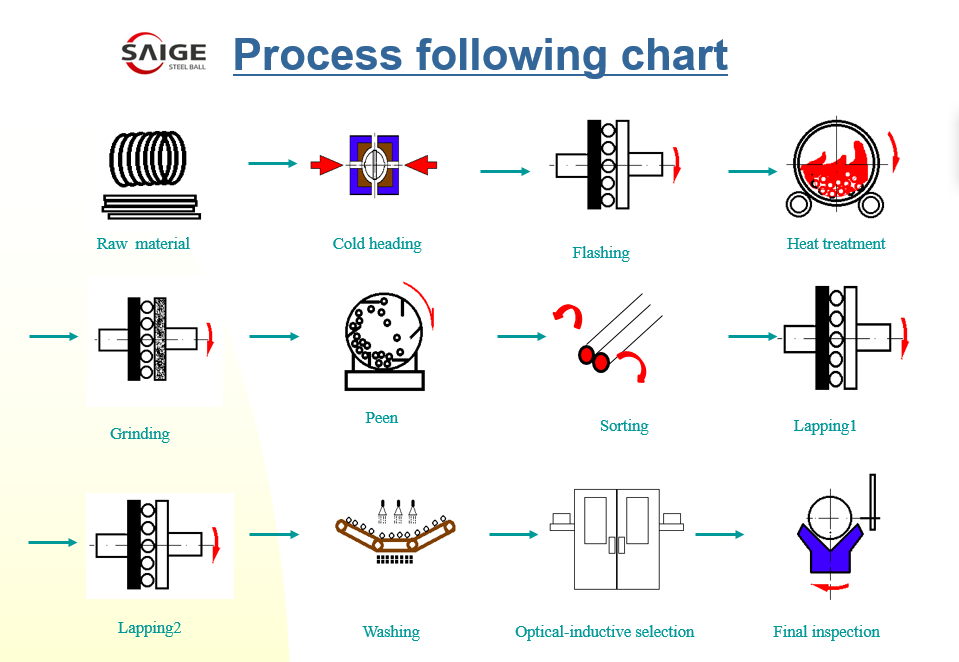
The first step in the manufacturing process begins with heading machines that precisely cut wire into short lengths and then form these segments into spherical shapes between specialized dies. This process requires careful calibration to ensure uniformity and the initial shape accuracy of the ball.
The first step in the manufacturing process begins with heading machines that precisely cut wire into short lengths and then form these segments into spherical shapes between specialized dies. This process requires careful calibration to ensure uniformity and the initial shape accuracy of the ball.
Deflashing
Once the wire segments are formed into rough spheres, they undergo a process known as deflashing. The flash line, a ridge left by the forming dies, must be removed to achieve a smoother surface. During this step, the balls are rolled between heavy, cast iron plates, which grind away the excess material, leaving behind a more refined shape.
Once the wire segments are formed into rough spheres, they undergo a process known as deflashing. The flash line, a ridge left by the forming dies, must be removed to achieve a smoother surface. During this step, the balls are rolled between heavy, cast iron plates, which grind away the excess material, leaving behind a more refined shape.
Soft Grinding
Following deflashing, the balls go through a soft grinding stage. Here, a grinding stone is used to further refine the surface and improve the precision of the spherical shape. Although the balls are still relatively soft, this step is crucial for laying the groundwork for the final dimensions and shape accuracy.
Following deflashing, the balls go through a soft grinding stage. Here, a grinding stone is used to further refine the surface and improve the precision of the spherical shape. Although the balls are still relatively soft, this step is crucial for laying the groundwork for the final dimensions and shape accuracy.
Heat-Treating
The next critical phase is heat-treating. Carbon steel balls are subjected to a process called carburizing, where they are heated to high temperatures in a carbon-rich atmosphere. This increases the carbon content near the surface of the balls, making them harder and more wear-resistant. After carburizing, the balls are quenched and tempered to achieve the desired hardness and case depth, ensuring that they can withstand the rigors of high-stress applications.
The next critical phase is heat-treating. Carbon steel balls are subjected to a process called carburizing, where they are heated to high temperatures in a carbon-rich atmosphere. This increases the carbon content near the surface of the balls, making them harder and more wear-resistant. After carburizing, the balls are quenched and tempered to achieve the desired hardness and case depth, ensuring that they can withstand the rigors of high-stress applications.
Descaling
After heat-treating, the balls are subjected to descaling. This step is essential for removing any residues and by-products that might have formed during the heat-treatment process. Specialized equipment is used to strip away these unwanted materials, preparing the balls for subsequent grinding and finishing operations.
After heat-treating, the balls are subjected to descaling. This step is essential for removing any residues and by-products that might have formed during the heat-treatment process. Specialized equipment is used to strip away these unwanted materials, preparing the balls for subsequent grinding and finishing operations.
Hard Grinding
The hard grinding stage is one of the most meticulous steps in the entire process. Using specialized grinding machines, the balls are slowly and precisely ground to achieve the exact size and sphericity required. Tolerances can be as tight as ±.0001 inches, ensuring that the balls meet the stringent specifications demanded by high-precision applications.
The hard grinding stage is one of the most meticulous steps in the entire process. Using specialized grinding machines, the balls are slowly and precisely ground to achieve the exact size and sphericity required. Tolerances can be as tight as ±.0001 inches, ensuring that the balls meet the stringent specifications demanded by high-precision applications.
Lapping
Lapping is another critical step that brings the balls to the stringent requirements of ISO 3290 Grade 10 - 48. Several proprietary lapping processes are employed to achieve the desired surface finish and dimensional accuracy. Lapping involves the use of fine abrasives to remove minute amounts of material, refining the surface until it meets the required standards.
Lapping is another critical step that brings the balls to the stringent requirements of ISO 3290 Grade 10 - 48. Several proprietary lapping processes are employed to achieve the desired surface finish and dimensional accuracy. Lapping involves the use of fine abrasives to remove minute amounts of material, refining the surface until it meets the required standards.
Finishing
The final step in the manufacturing process is finishing. Proprietary chemical and mechanical processes are applied to give the balls their final micro-smoothed finish. This treatment enhances the wear resistance and extends the product’s longevity, ensuring that the balls can operate smoothly and efficiently in demanding environments.
The final step in the manufacturing process is finishing. Proprietary chemical and mechanical processes are applied to give the balls their final micro-smoothed finish. This treatment enhances the wear resistance and extends the product’s longevity, ensuring that the balls can operate smoothly and efficiently in demanding environments.
Inspection
Quality assurance is paramount throughout the manufacturing process. All products pass through at least two 100% inspection stages, utilizing proprietary, automated inspection processes. These inspections verify that each ball meets the specified tolerance levels and quality criteria before being released for distribution.
Classification of steel balls
Why high chrome steel balls are widely used?