
Why does the steel ball break?
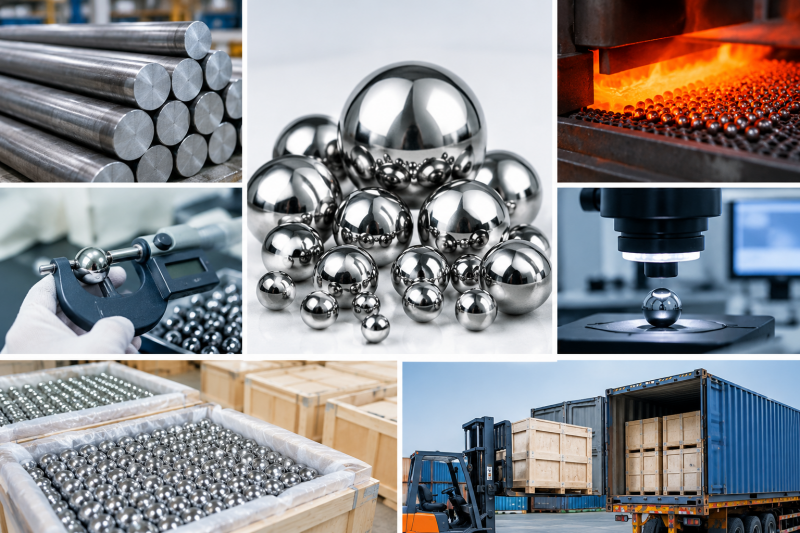
The reason why the steel ball is round is due to physical changes. The round steel bars and square steel bars, which are neat or irregular, are heated and are shaped by free forging by the die when they reach a certain set temperature.
But when we use steel balls as grinding media, we will find that some steel balls are broken. Is this just because the quality of the steel balls is not good? Changzhou Feige Steel Ball Manufacturing Co., Ltd. will explain why.
We need to clarify why the steel ball is broken. A fundamental problem that steel balls will break is internal stress:
To put it simply, internal stress is a measure of the degree of deformation, strength, impact toughness, and other physical quantities related to the failure of the object; in layman's terms, internal stress is the internal pressure.
The steel ball cannot be used immediately after forging, but should be left unused first. This is to eliminate the internal stress of the forging, which is due to the uneven internal structure of the newly forged steel ball, tightness and looseness.
If the workpiece that has just been forged is immediately taken to a lathe for processing, the finished work is measured with a dial indicator and caliper, and the dimensional accuracy fully meets the requirements of the drawing, but after a short period of time, the dimensional accuracy is unqualified. Where is the problem? The internal stress of the forging has not been completely eliminated, causing the deformation of the workpiece.
The solution is to do not rush to process, throw the workpiece aside, and wait for its internal stress to be completely eliminated, the internal structure is uniform, loose and compact, and then to process, the size of the processed workpiece will not change. Eliminate internal stress from forgings or steel balls
Now that we talk about internal stress, we might as well extend it and share with you four methods for relieving internal stress in steel balls:
- Gas Furnace: Gas furnaces are typically used for larger batches of steel balls. They offer good temperature uniformity across the batch and are suitable for operations where fuel costs are a consideration.
- Oil Furnace: Oil furnaces are another option for tempering, though they may require more maintenance due to the nature of oil combustion. They are useful in situations where electric or gas furnaces are not readily available or economically viable.
- Heat Preservation: After forging, the steel balls are kept at a high temperature for a specified duration to allow the residual heat to penetrate thoroughly.
- Natural Cooling: Once the heat preservation phase is complete, the steel balls are allowed to cool naturally. This method is energy-efficient as it utilizes the heat already present in the material without the need for additional heating sources.
- Ball Segment Separator: In this method, the steel balls are separated and subjected to impacts that help relieve internal stresses. This method is effective in achieving uniform properties across the surface of the steel balls.
- Barrel Impact Method: Here, the steel balls are placed inside a rotating drum or barrel where they collide with each other repeatedly. The collisions act as a form of tempering, helping to distribute the stresses more evenly and improve the overall durability of the steel balls.
- Stress Relief: After the initial heat treatment, the steel balls are left undisturbed in a controlled environment where they can gradually release any residual stresses.
- Natural State: This process does not involve any active manipulation, such as heating or mechanical impact. Instead, it relies on the inherent properties of the material to reach a state of equilibrium.
If you need to purchase large quantities of steel balls, please contact Changzhou Feige Steel Ball Manufacturing Co., Ltd. We have a large amount of stock available for sale, and we also accept customers' special customization requirements.
Reasons for the rough surface of the refined steel ball
Steel balls for airbags use