
Material Introduction: Properties & Advantages of 302 Stainless Steel Balls
author: P
2026-07-30
Material Introduction: Properties & Advantages of 302 Stainless Steel Balls
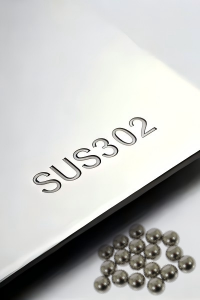
Grade 302 is a typical 18-8 austenitic stainless steel. It is often compared with 304 due to similar alloy systems, while the difference in carbon content creates distinctive mechanical behaviors. As a well-established general stainless steel grade, 302 stainless steel balls feature reliable rust resistance and remarkable work-hardening capacity. They are widely adopted in valve cores, spray equipment, small precision valve assemblies, stirring units, general hardware and light industrial machinery. Many purchasers lack clear understanding of the applicable limits of 302 material. This article illustrates its chemical features, core strengths and typical working conditions, and introduces standardized manufacturing and comprehensive material verification capabilities of Changzhou Feige Steel Ball Co., Ltd.
In terms of chemical composition, the maximum carbon content of 302 reaches 0.15%, higher than conventional 304 stainless steel. Higher carbon content cannot directly raise hardness under annealed status, yet it delivers strong work-hardening effect. After cold processing such as rolling and polishing, tensile strength and surface hardness of steel balls increase obviously. It brings unique merits for applications requiring both rust protection and moderate surface wear resistance and extrusion resistance. Stable chromium and nickel composition enables the material to form dense passive films in atmospheric environments, fresh water and most weakly corrosive organic media, offering dependable anti-rust performance. It should be noted that 302 contains no molybdenum, so its pitting resistance under high chloride salt spray is inferior to 316 series. The risk of intergranular corrosion rises under long-term sensitized high-temperature conditions compared with low-carbon stainless grades.
Generally speaking, 302 stainless steel balls possess four prominent advantages. Firstly, outstanding cold work strengthening effect. Higher surface strength can be achieved via precision finishing without extra heat treatment. Secondly, stable forming and polishing performance. High-gloss spherical surfaces can be easily produced, satisfying strict smoothness requirements for valve sealing and fluid stirring components. Thirdly, excellent room-temperature toughness and impact resistance, resisting brittle fracture. Fourthly, balanced overall cost. It serves as a cost-effective stainless steel option for working conditions without severe corrosive media. The material is basically non-magnetic after annealing, and weak magnetism emerges after cold working, which is a normal characteristic of austenitic stainless steel and will not interfere with regular service.
Working condition evaluation is essential during material selection. 302 stainless steel balls fit atmospheric environments, fresh water, daily chemical products, mild food contact and general sealing valves. They are not recommended for continuous service in seawater, heavy salt spray or strong acid and alkali media. 316 series is preferred for long-term chloride-rich corrosive environments. Low-carbon stainless grades are more suitable if massive welding processes are involved without post-weld heat treatment.
As a national high-tech enterprise, Feige Steel Ball supplies 302 stainless steel balls in a full range of sizes and precision grades. Our physical and chemical laboratory is equipped with direct-reading spectrometers, hardness testers and metallurgical observation devices to conduct regular inspection of raw material composition and finished mechanical properties, preventing material mixing risks. Certified by IATF16949 and ISO9001 quality systems, we provide objective material evaluation according to customers’ service conditions and supply traceable material test certificates for every batch. A complete traceability chain covering incoming raw material inspection to finished delivery guarantees stable long-term performance of 302 stainless steel balls for diverse light industry and general precision equipment.

Popular Science: Advantages & Properties of 204 Cu Stainless Steel Balls
Material Analysis: 316 vs 316L Stainless Steel
Related Article

This article elaborates the core material advantages of carbon steel slingshot balls in density stability, deformation resistance and cost performance, and analyzes the technical differences between high-precision finished products and ordinary products. It highlights Feige Steel Ball’s standardized production technology and rigorous full-index testing system, proving our capability to deliver stable, high-precision carbon steel slingshot balls for diverse outdoor shooting scenarios.
Advantages of Carbon Steel Slingshot Balls in Material and Intelligent Manufacturing
440A and 440C are high-performance martensitic stainless steel balls, superior to the 420 series in hardness and wear resistance. Graded carbon content creates distinct toughness, hardness and fatigue resistance, ideal for high-load precision bearings, valve cores and automotive precision components.
440A vs 440C Stainless Steel Balls: Performance Differences & Industrial Selection Guide
420 series martensitic stainless steel includes 420A, 420B and 420C grades with graded carbon content. They differ greatly in hardness, toughness and wear resistance. This guide helps you select the right 420 steel ball for precision wear-resistant industrial scenarios.
420A vs 420B vs 420C Stainless Steel Balls: Differences, Properties & Applications
420 stainless steel is a typical martensitic high-hardness steel. 420 stainless steel balls feature heat-treatable high hardness and excellent wear resistance, widely used in precision bearings, valve seals, medical devices and food machinery for dry and high-wear working scenarios.
Popular Science: Advantages and Application of 420 Stainless Steel Balls