
How to Pack Steel Balls for Export: Rust Prevention, Container Sweat and ISPM 15 Compliance
Steel balls are high-value, low-volume and unusually sensitive to moisture. A shipment spends thirty-five days at sea, and when the container is opened there are rust stains on the top layer of cartons. Nine times out of ten the balls were fine when they were packed — one of the three packaging layers failed somewhere between the factory and the destination port. Export packing has to solve three separate problems: keep corrosive media away from the steel, cancel the condensation created by temperature swings inside the container, and satisfy the destination country's wood packaging rules.
Three layers, three different risks
Primary packaging touches the balls and blocks moisture and corrosive gases. This is the rust-preventive layer: oil film, VCI film, or a vacuum foil bag.
Secondary packaging cushions and unitizes. Cartons, plastic pails, steel or fibre drums — the requirement is compression strength and, just as important, preventing ball-to-ball contact. Point contact between balls under load produces scratches that no rust-preventive film can undo.
Tertiary packaging carries stacking and handling loads: pallet, wooden case, stretch wrap. It decides damage rate at loading and discharge.
These are not interchangeably "just packaging". A single polyethylene bag inside a carton that collapses under stacking, on a pallet with no stretch wrap, will arrive deformed and torn — and the best oil film in the world will not help.
Rust prevention: how to combine the four tools
Rust-preventive oil is the workhorse. A dry film of roughly 1–3 µm is typical for thin-film protection. The failure mode is not the oil type but the uniformity: too thick and the customer has to degrease before assembly, too thin and the asperity peaks on the ball surface are left exposed. Fix the oil quantity by ball size and pack format in the process sheet, not by operator judgement.
VCI (vapour corrosion inhibitor) film suits small packs and long transit. The inhibitor saturates the enclosed air and reaches surfaces that an oil film misses, including the gaps between tightly packed balls. It only works in an enclosed volume — which means the bag must stay sealed, and the metal should be within roughly 30 cm of the film. A torn VCI bag offers little protection.
Vacuum foil bags target high-value, high-precision parts: G5 and finer bearing balls, mirror-polished balls. An aluminium foil laminate, evacuated and sealed with a desiccant sachet, almost eliminates the water vapour and oxygen path and can hold a rust-free condition for twelve months or more. The trade-off is cost, plus a reseal requirement once the customer opens the bag.
Desiccant handles residual moisture. Silica gel and montmorillonite are the safe choices. Size it on internal volume, route, transit days and temperature swing — not on cargo weight. A sachet thrown into each carton "for luck" is a cost, not a control. Avoid calcium chloride near stainless steel: chloride is exactly what attacks 304 and 316L.
The combination logic is straightforward. Short domestic or regional delivery: oil plus a sealed polyethylene bag. Four to six weeks at sea with standard precision: oil, VCI bag and correctly sized desiccant. Critical parts, long route, or a customer who inspects on opening: vacuum foil.
One rule that gets skipped: pack dry. Oil applied over residual grinding fluid or washing water simply traps the moisture underneath the film.
The real enemy at sea is condensation
Steel balls do not generate moisture; the container does. In daylight the roof heats to 50–60 °C and the air inside holds a large amount of vapour. Overnight the roof cools, the air reaches dew point, and water condenses on the ceiling and on the top of the stack. The industry calls it container rain, and it lands exactly where the packaging is most exposed — the top cartons and the outer corners.
It is worth separating two mechanisms. Container sweat forms on the container's own surfaces when warm, humid air inside is cooled by the night. Cargo sweat forms on cold cargo when it enters a warm, humid environment. Both put liquid water on your packaging; the countermeasures overlap but the desiccant sizing does not.
Five practical controls:
- Keep the inner packaging sealed, so container humidity cannot reach the steel.
- Use container desiccant — hanging bags or a liner — sized to the container's internal volume and the number of transit days, not only to the cartons.
- Leave a gap of roughly 30 cm below the roof and keep cargo away from the doors, so air can circulate and condensation does not sit on the load.
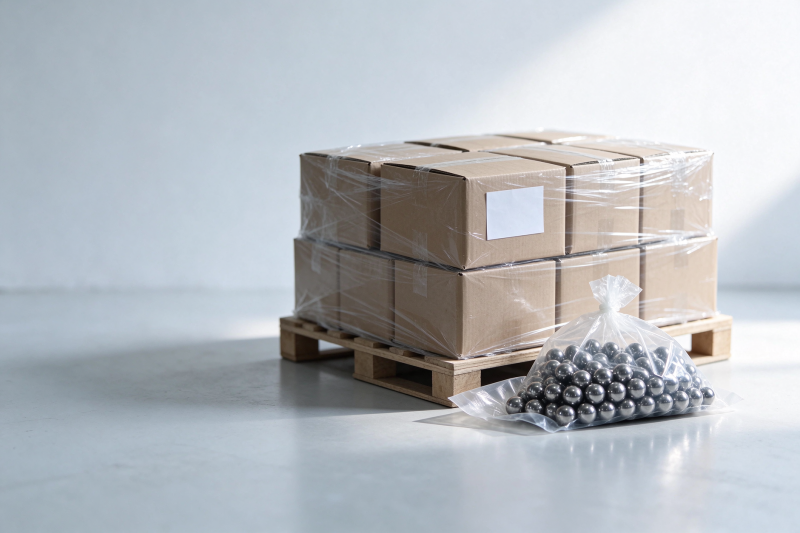
- Stretch-wrap the pallet as a unit. Condensation then forms on the film rather than inside the carton.
- Avoid loading warm cargo, and avoid loading in rain or at very high ambient humidity, which adds free water to the container before departure.
If the customer needs a verifiable rust-prevention period, put it into the contract as a test method rather than a promise: neutral salt spray to ASTM B117 for 48 hours with no red rust is a figure both sides can reproduce. For stainless grades, specify pitting rather than red rust, since the failure mode is different.
The compliance red line: ISPM 15
Any solid-wood packaging — pallets, crates, dunnage — must be treated under ISPM 15, either by heat treatment (core temperature of 56 °C for 30 minutes) or by methyl bromide fumigation where still permitted, and marked with the IPPC logo, country code, producer code and treatment code.
Unmarked wood packaging is held, returned, fumigated at destination, or destroyed. The cost of that treatment routinely exceeds the value of the goods, and the delay lands on the customer's production line. Processed wood such as plywood is treated differently under the standard, but do not assume the exemption applies — confirm with the supplier and keep the treatment certificate with the shipping documents.
This problem is invisible at the factory gate, which is why it belongs in the packaging specification rather than in the shipping checklist.
Labels and traceability
A workable label carries the grade, ball size, precision grade, batch and heat number, quantity, production date and rust-preventive expiry date. Mixed batches in one carton are the single most common cause of downstream complaint: every batch may be inside tolerance, but the customer's preload scatter rises and, when something fails, nobody can trace it back to a heat of steel. Pack by batch, and let the label carry the batch identity.
Where export shipments usually fail
Desiccant cut in half to save cost, on a route that crosses typhoon season. An inner bag sealed with tape only, torn by a pallet corner in transit. Several sizes mixed in one carton, forcing the customer to re-sort. A pallet without an IPPC mark. Cargo loaded on a rainy afternoon at high humidity. None of these is difficult to prevent; all of them are expensive to fix after discharge.
How Feige packs export orders
Every batch at Feige is fully inspected before release, with diameter, tolerance and roundness verified on a three-pin gauge and inspection data retained by batch and heat number. Raw material is electric-furnace + LF + VD refined chrome steel at ≤5 ppm oxygen, which controls inclusions at the source; sizes run from 0.3 mm to 25.4 mm, with G3 and finer available on request and stock sizes shipping within 48 hours.
Export packing can be configured to the route: rust-preventive oil, VCI film, vacuum foil bags and desiccant, in cartons, pails, drums or wooden cases. Pallets and crates are ISPM 15 treated and marked, and labels can follow the customer's own format so the goods can be checked against the packing list on opening. Feige has manufactured precision steel balls since 1989 and exports to 18 countries, including the UK, the US and Japan, with test reports supplied with each shipment.
Packaging is the cheapest insurance in the order. Specify it at quotation stage — the cost of a desiccant bag is trivial next to a rejected container.
Send us the ball size, grade, destination port and transit time, and we will confirm an export packing configuration for your route.
How to Judge Surface Defects on Steel Balls: Scratches, Pits and Cracks
Related Article