
How to Select the Right Stainless Steel Ball Based on Working Environment
Stainless steel balls are indispensable components widely applied in industrial valves, precision bearings, food and beverage filling equipment, water treatment systems, medical instruments, chemical processing units, automation actuators and sanitary piping systems. Many engineers encounter unexpected failures such as surface rust, pitting corrosion, rapid abrasion, leakage and shortened service life of steel balls during operation. Most of these issues do not stem from inferior manufacturing quality, but from improper material selection that fails to match the actual working conditions.
It is a common misunderstanding that stainless steel will never rust. In fact, stainless steel only relies on a passive chromium oxide film on its surface to resist corrosion. Once this protective layer is damaged by chloride ions, acid, high humidity or mechanical friction, corrosion will occur. Different stainless steel grades have distinct chemical compositions, hardness levels, wear resistance and corrosion tolerance. Choosing the correct grade can stabilize equipment performance, reduce downtime and cut long-term replacement and maintenance costs.
201 Stainless Steel Ball
201 stainless steel is a budget-friendly austenitic grade with low nickel content. It is suitable for dry indoor environments, mainly used for counterweights, decorative fittings and simple mechanical structures that have no contact with water, mist or corrosive liquids. Its anti-rust performance is relatively limited. It is not recommended for humid workshops, outdoor exposure, coastal areas, washing cycles or direct food contact. Under damp or salty conditions, brown rust spots will form quickly. It is only suggested for non-critical, dry applications where cost control is the primary concern.
304 Stainless Steel Ball (SUS304)
SUS304 is the most versatile and widely used stainless steel ball on the market. It offers balanced corrosion resistance, excellent machinability and can be polished smoothly to meet general hygienic standards. It works reliably in fresh water, drinking water pipelines, bathroom valves, general food processing lines and routine cleaning scenarios. For most indoor industrial environments without salt or chlorine enrichment, 304 is the preferred cost-effective option. Nevertheless, 304 has poor resistance to chloride ions. Continuous exposure to seawater, brine, coastal salt spray or repeated chlorine disinfection will break down its passive film and cause irreversible pitting corrosion.
316L Stainless Steel Ball (SUS316L)
316L contains molybdenum, an alloying element specially added to boost resistance against chloride pitting corrosion. The low-carbon formula further improves its ability to resist intergranular corrosion after repeated heating and cleaning cycles, such as CIP (Clean-in-Place) processes in food and pharmaceutical factories. This grade is the top choice for harsh environments including coastal salt spray, seawater equipment, swimming pool systems, brine circuits, biochemical analyzers and sanitary production lines with frequent chemical disinfection. One obvious limitation should be noted: 316L is an austenitic stainless steel and cannot be hardened via heat treatment. Its low hardness makes it unsuitable for high-speed rolling bearings and heavy-load friction applications, where fast wear will happen.
420 & 440C Stainless Steel Ball
440C is a high-carbon martensitic stainless steel. After quenching and tempering, it reaches high hardness and outstanding wear resistance, comparable to bearing steel. It is the first pick for precision bearings, high-pressure valve cores, hydraulic components and lubricated rolling systems where wear resistance is the core requirement. However, its corrosion resistance is weak; it should only be used in dry or oil-lubricated environments free of salt and acid. 420 stainless steel acts as a middle-tier solution. It delivers moderate hardness and basic rust protection. It fits light-duty valves and general hydraulic parts where light abrasion is expected while corrosion risk remains low.
Zirconia Ceramic Ball – Alternative for Extreme Corrosion
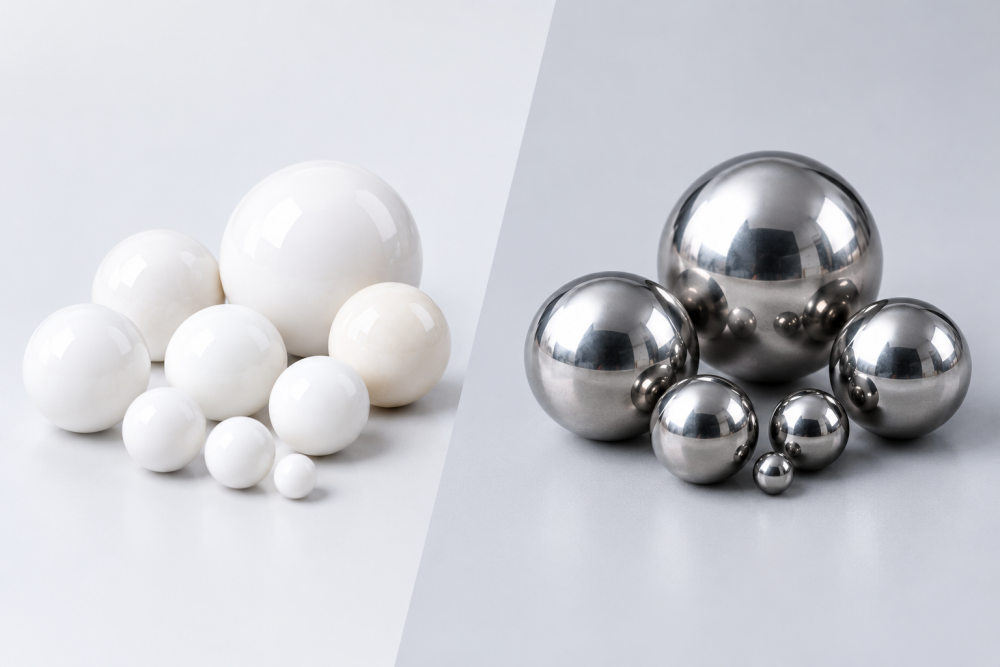
When the working medium involves concentrated acid, strong oxidizing agents or highly corrosive chemicals, ordinary stainless steel grades cannot survive. Zirconia ceramic balls provide superior corrosion resistance and maintain stable performance in aggressive media. The main drawback is brittleness. They are vulnerable under impact, heavy shock and point loads, so they are not suitable for impact-intensive working conditions.
Apart from material grade, you also need to specify precision grade, surface roughness and finishing requirements. High-precision bearings and tight-sealing assemblies demand G3 or G5 ultra-precision balls with mirror polishing to guarantee roundness and smooth running. For counterweights, simple check valves and low-demand flow controls, lower precision grades such as G100 or G200 are sufficient. Hygienic applications require ultra-smooth surfaces to avoid material residue and facilitate thorough cleaning.
Quick Selection Cheat Sheet
- Dry indoor use, cost priority: 201 stainless steel ball
- Fresh water, general food & sanitary applications: 304 stainless steel ball
- Salt spray, seawater, brine, frequent CIP disinfection: 316L stainless steel ball
- Precision bearings, high-pressure valves, wear priority & low corrosion: 440C stainless steel ball
- Mild wear, light-duty valves with basic anti-rust demand: 420 stainless steel ball
To sum up, the selection logic starts with analyzing corrosive substances in your working environment, then confirming whether corrosion resistance or wear resistance is your main priority. Combine that with precision, surface finish and hygiene standards, and you can identify the most suitable stainless steel ball for your project.
If you can share detailed parameters including working medium, operating temperature, load condition and exposure to salt or chemicals, our team can provide tailored material suggestions and sample support.
How to Choose the Right Steel Balls for Industrial Applications?
Related Article