
Analysis of the Influence of Precision Steel Ball Surface Roughness on Bearing Service Life
2026-09-22
Precision steel balls are core rolling components of industrial bearings, directly affectingbearing service life and mechanical operational stability. Most procurement and engineering teams prioritize steel ball accuracy grade, hardness, and dimensional tolerance while overlooking precision steel ball surface roughness — a critical parameter that dominates bearing friction coefficient, heat generation, and wear resistance. This article conducts an in-depth analysis of how steel ball surface roughness influences bearing durability, offering professional steel ball selection guidance for various industrial application scenarios.
1. Definition and Industry Standards of Precision Steel Ball Surface Roughness
Precision steel ball surface roughness refers to micro uneven textures on polished steel ball surfaces, a key inspection index to evaluate steel ball polishing quality, surface finish and manufacturing precision. It is one of the most essential technical parameters for qualifying high-quality precision steel balls for bearing assembly.
In compliance with the national standard GB/T 308-2019, precision steel balls of different accuracy grades have strict classified limits on surface roughness. G3 and G5 ultra-precision steel balls with ultra-low surface roughness are widely adopted in high-end precision bearings, medical devices and aerospace equipment. G10 to G100 general precision steel balls are mainstream products for standard industrial bearings and transmission systems. As a reliable manufacturer,Changzhou Feige Steel Ball implements full inspection on the surface roughness, roundness and dimensional accuracy of all finished precision steel balls, ensuring consistent surface finish and stable performance for bearing matching.
2. Four Major Impacts of Excessive Roughness on Bearing Service Life
2.1 Aggravating Friction and Wear to Shorten Bearing Life
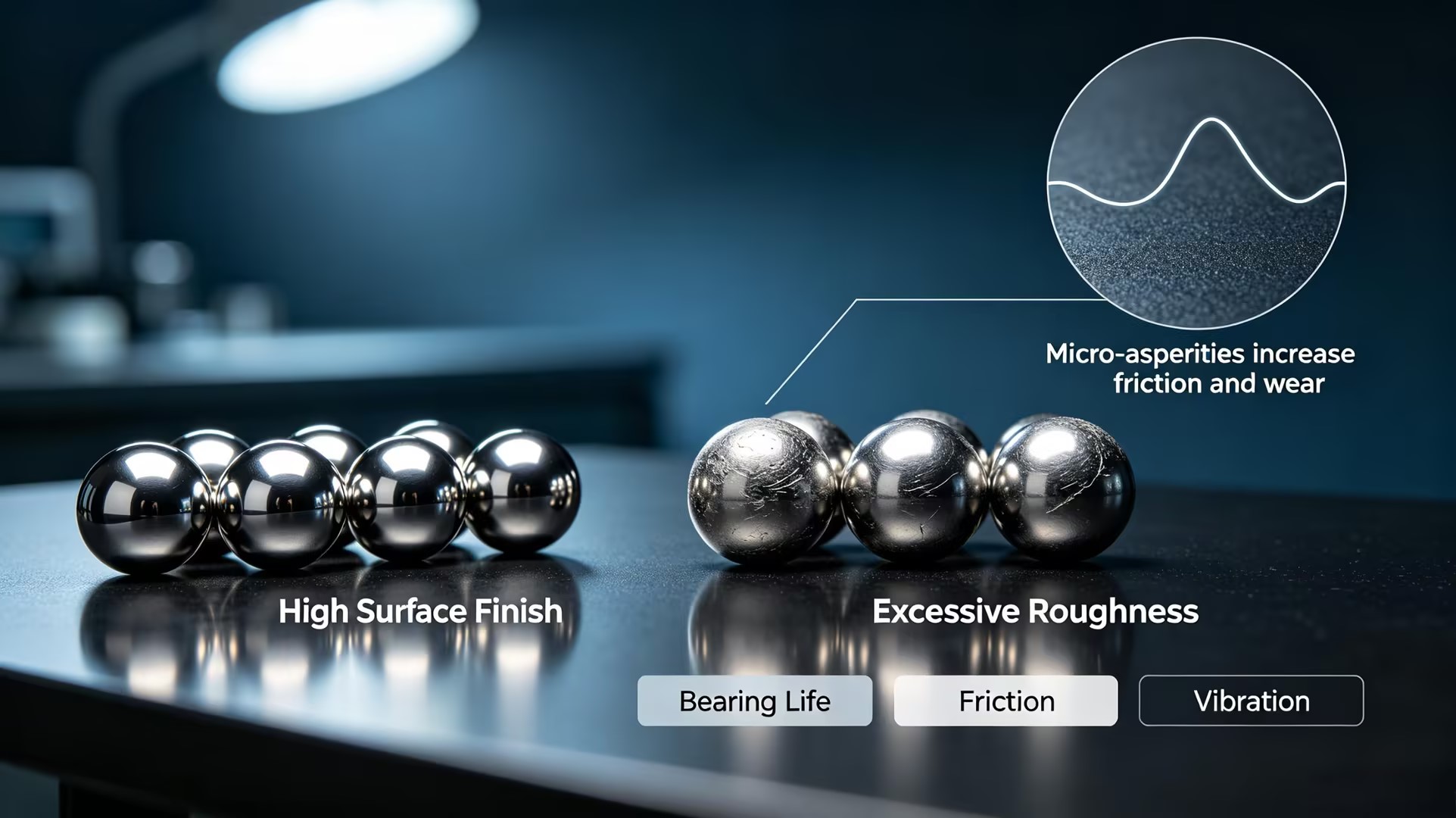
Excessive surface roughness of precision steel balls creates tiny protrusions on spherical surfaces, changing the ideal surface contact between steel balls and bearing raceways into unstable point contact. During continuous mechanical operation, these micro protrusions constantly scratch bearing raceways, producing metal debris and causing progressive wear on both precision steel balls and bearing inner structures. This enlarges internal bearing clearance, triggers early component failure, and drastically shortens overall bearing service life.
2.2 Rising Operational Temperature and Early Lubrication Failure
High steel ball surface roughness increases the rolling friction coefficient of precision steel balls inside bearings. Under high-speed operating conditions, excessive friction leads to rapid temperature rise within bearing assemblies. Continuous high temperature accelerates oxidation and carbonization of lubricating grease, resulting in early lubrication failure. Without effective lubrication, direct dry friction occurs between precision steel balls and raceways, greatly increasing wear rate and causing common bearing faults including abnormal noise, overheating and component locking.
2.3 Triggering Vibration and Abnormal Noise to Affect Equipment Precision
High-precision equipment such as automated machinery, industrial robots and high-speed motors requires stable bearing operation. Uneven precision steel ball surface roughness causes unbalanced force distribution during bearing rotation, generating persistent vibration and abnormal operating noise. Long-term unstable operation reduces equipment precision, induces mechanical fatigue damage, and accelerates aging and scrapping of precision bearings equipped with substandard steel balls.
2.4 Generating Corrosion Stress and Reducing Fatigue Resistance
Steel balls with poor surface roughness have micro gaps on spherical surfaces that easily absorb moisture, dust and oil contaminants, forming localized corrosion spots. Under cyclic alternating loads, these corroded areas become stress concentration points, triggering fatigue cracks and surface peeling on precision steel balls. This is a major cause of premature fatigue failure of industrial bearings.
3. Roughness Selection Principles for Precision Steel Balls Under Different Working Conditions
Reasonable matching of precision steel ball surface roughness with working conditions is critical to balancing bearing performance and manufacturing cost. Blind pursuit of ultra-low roughness will cause cost waste, while excessive roughness will reduce bearing service life. The targeted selection principles are as follows:
High-speed precision scenarios: Precision machine tools, medical equipment and high-speed motor bearings require G3/G5 ultra-low roughness precision steel balls to minimize friction vibration and maintain long-term high-precision operation.
General industrial scenarios: G10-G50 standard precision steel balls with qualified surface roughness are ideal for general machinery and automation equipment bearings, perfectly adapting to conventional load and speed requirements.
Heavy-load low-speed scenarios: Heavy machinery and low-speed transmission bearings allow appropriately relaxed roughness standards, but the adopted precision steel balls must be free of scratches and pits to avoid stress concentration and premature wear failure.
4. Controlling Steel Ball Quality at the Source to Ensure Long-term Bearing Life
The overall performance and service life of bearings depend largely on the polishing process and quality control of precision steel balls. As a professional precision steel ball manufacturer in Changzhou, Feige Steel Ball has focused on steel ball manufacturing for over 30 years. We have built a complete surface roughness control system, eliminating micro surface defects through refined polishing and strict finished product testing, to provide high-precision steel balls with uniform and stable surface finish.
We supply full-specification low-roughness chrome steel balls and stainless steel balls for bearing and precision equipment matching. Our high-quality precision steel balls effectively solve common bearing problems including severe wear, short bearing service life, vibration and abnormal noise, helping global clients optimize product performance and reduce operational and maintenance costs.
5. Conclusion
Precision steel ball surface roughness is an indispensable core parameter that determines bearing service life, operational accuracy and mechanical stability. Unqualified steel ball surface roughness will trigger wear, overheating, vibration and fatigue corrosion, greatly shortening bearing service cycle. Selecting high-finish, stable precision steel balls is an effective way for bearing manufacturers to improve product quality and market competitiveness.
In the future, Changzhou Feige Steel Ball Co., Ltd. will continue to optimize polishing technology and roughness testing standards, strictly control every production link of precision steel balls, and provide high-quality, low-roughness steel ball solutions for global precision bearing and mechanical equipment enterprises.
304 vs 316 Stainless Steel Balls: Which Grade to Choose?
Related Article

This article elaborates the core material advantages of carbon steel slingshot balls in density stability, deformation resistance and cost performance, and analyzes the technical differences between high-precision finished products and ordinary products. It highlights Feige Steel Ball’s standardized production technology and rigorous full-index testing system, proving our capability to deliver stable, high-precision carbon steel slingshot balls for diverse outdoor shooting scenarios.
Advantages of Carbon Steel Slingshot Balls in Material and Intelligent Manufacturing
440A and 440C are high-performance martensitic stainless steel balls, superior to the 420 series in hardness and wear resistance. Graded carbon content creates distinct toughness, hardness and fatigue resistance, ideal for high-load precision bearings, valve cores and automotive precision components.
440A vs 440C Stainless Steel Balls: Performance Differences & Industrial Selection Guide
420 series martensitic stainless steel includes 420A, 420B and 420C grades with graded carbon content. They differ greatly in hardness, toughness and wear resistance. This guide helps you select the right 420 steel ball for precision wear-resistant industrial scenarios.
420A vs 420B vs 420C Stainless Steel Balls: Differences, Properties & Applications