
Forged vs. High Chrome Cast Grinding Media: How to Cut Ball Mill Costs by 20%
In mining mineral processing, cement manufacturing, and thermal power plant desulfurization, grinding media represent one of the single largest operating expenses in ball mill circuits. When evaluating procurement options, plant operators and procurement managers often face a fundamental dilemma: should purchasing strategies prioritize the lowest initial price per ton, or optimize for long-term wear performance?
Field data from global processing plants consistently shows that chasing low-cost, inferior steel balls creates significant hidden operating penalties. High spalling rates, severe ball breakage, accelerated loss of sphericity, and escalating motor power consumption (kWh/t) quickly erode any upfront purchase savings. When frequent media re-charging labor and unplanned downtime are added to the balance sheet, the total processing cost per ton of ground material actually increases. Achieving genuine cost optimization requires shifting from a simple unit-price mindset to a comprehensive total cost of ownership evaluation.
Metallurgical Profiles: Toughness vs. High Hardness
The two prevailing types of industrial grinding media—forged alloy steel balls and high chromium cast balls—feature distinct metallurgical structures that dictate their performance inside a tumbling mill.
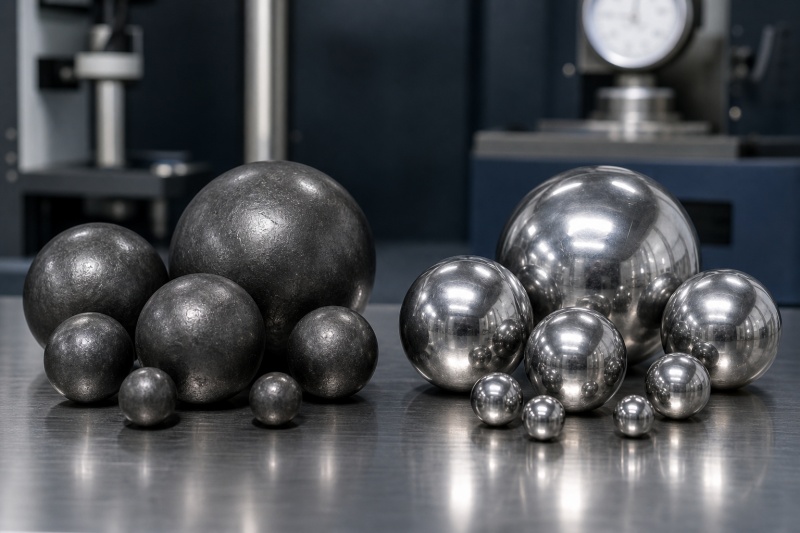
Forged steel balls are typically manufactured from specialty alloy steel billets such as 60Mn, 65Mn, B2, or B3 grades. Formed through high-temperature rotary rolling or die forging followed by precise quenching and tempering, they develop a fine-grained, homogeneous tempered martensite microstructure. This gives forged balls outstanding impact toughness (typically ≥12–18 J/cm2≥12–18 J/cm2) and an exceptionally low breakage rate (consistently below 0.5%), allowing them to withstand violent shock loads without catastrophic fracturing.
High chrome cast balls, by contrast, are produced by melting selected steel scrap and ferrochrome in electric induction furnaces, with chromium contents ranging from 10% to 28%. Their microstructure features extremely hard eutectic chromium carbides (M7C3M7C3 type) distributed within a martensitic matrix. This delivers uniform through-hardness reaching HRC 60–66 and exceptional resistance to both abrasive and corrosive wear in chemical or wet slurry environments. However, their lower impact toughness makes them more susceptible to spalling or cracking under extreme drop-weight impacts.
Application Matching: Primary Crushing vs. Fine Grinding
These differing material properties establish clear operational roles for each media type across the grinding circuit.
For large-diameter ball mills (Φ>4.5mΦ>4.5m), semi-autogenous grinding (SAG) mills, and primary coarse-grinding chambers with large feed sizes (>15–25mm>15–25mm), the kinetic drop energy inside the shell is immense. Under such severe crushing conditions, high-toughness, impact-resistant forged alloy steel balls are the reliable choice to crush coarse ore effectively without breaking or damaging mill shell liners. Their low fracture rate also prevents broken fragments from blinding discharge grate slots and damaging downstream slurry pumps.
Conversely, in secondary or tertiary fine-grinding compartments—such as cement finish grinding, coal pulverizers, or corrosive flotation feed circuits—the primary wear mechanism shifts from impact crushing to surface abrasion and micro-cutting. In these environments, high chrome cast balls excel. Their high hardness and chemical passivity deliver wear rates two to three times lower than standard carbon steel balls, maintaining consistent ball charge grading and stable specific surface area over extended operating campaigns.
The 20% Cost Reduction Strategy: Dual-Media Pairing & Charge Optimization
Consequently, reducing total milling expenditure by 20% relies not on completely favoring one product type over another, but on compartment-specific ball pairing and scientific media charge grading.
Total grinding operating cost combines media consumption expenses, specific power draw, liner wear amortization, and maintenance downtime. Implementing a dual-media strategy—deploying large-diameter forged balls in the primary chamber for impact crushing and small-to-medium high chrome cast balls in the secondary chamber for abrasion resistance—maximizes the mechanical strengths of both materials.
Furthermore, tailoring the ball charge size distribution curve to match the actual ore work index and feed-to-product size ratios reduces interstitial void volume and unproductive metal-to-metal contact, typically yielding an 8% to 12% reduction in grinding energy consumption. Combined with rigorous quality verification of surface-to-core hardness gradients (≤3 HRC≤3 HRC) and progressive drop-ball fatigue testing (>10,000>10,000 drops at 3.5m without failure), plants can eliminate unscheduled shutdowns and substantially lower fixed processing costs.
Mill efficiency optimization is not a matter of aggressive commercial price bargaining; it is a calculated metallurgical and operational balance. Matching the right grinding media to specific operating zones allows processing plants to achieve higher throughput, lower energy consumption, and extended consumable service life.
Analysis of the Influence of Precision Steel Ball Surface Roughness on Bearing Service Life
Related Article
